CASFOR-II: Modelling Carbon Sequestration in Forested Landscapes
The general objectives of this project are to
- develop a general model for estimating carbon balance and carbon sequestration capacity in forested landscapes or regions
- disseminate the developed CO2FIX model amongst the user-community via the Internet
The development of the existing, stand-level carbon budget model CO2FIX will explicitly consider
- landscape level aspects of climate change mitigation projects
- reliability of modelling tree growth and soil carbon
- choices and definitions of adopted articles of the Kyoto protocol
- permanence, accounting and cost efficiency of carbon sequestration
- bioenergy options
The developed CO2FIX model is intended to provide users with a tool to analyse the outcome of different ARD and forest management options as specified in the Kyoto protocol. It will be applied to three to four case study regions in CASFOR-II project.
Workpackages
The specific scientific and technical objectives correspond to the following work packages:
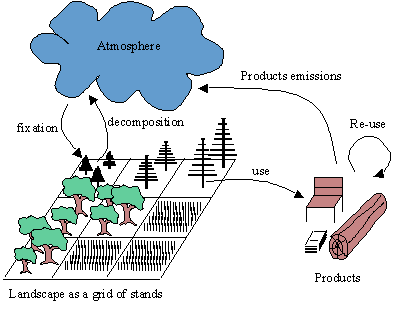
WP1: Adaptation and further development of the model CO2FIX for use at the project and landscape level, using land use and land cover data as basic inputs in an elementary GIS framework.
WP2: Model development: expansion of the modules for soil organic matter, selective logging, mixed stands, etc. for a range of forest- and agroforestry- ecosystems world-wide
WP3: Parameterisation of the model for a wide range of forest and agroforestry ecosystems in the tropics, and selection of 3-5 specific case studies for model testing and evaluation
WP4: Specification of ARD options and consequences for carbon budgets of land use change, including an elementary assessment of the cost of carbon sequestration under various ARD options
WP5: Extension of the model with an option for bio-energy and mitigation of greenhouse effect enhancement through substitution of biomass for fossil fuel
WP6: Dissemination of the model via an Internet site (information site, model downloading, user platform, model comparisons, data sharing, user meetings, information clearing house, etc.)
Last updated: